

The india women’s national cricket team vs australia women’s national cricket team rivalry is one of the most exciting contests in international women’s cricket. These two teams have consistently delivered competitive matches across Test cricket, One Day Internationals (ODIs), and Twenty20 Internationals (T20Is). Australia have built a reputation for their consistency, tactical discipline, and success in major tournaments, while India have developed into a formidable side with technically gifted batters, versatile all-rounders, and talented bowlers.
Matches between these teams attract considerable attention because they often feature high-quality batting, aggressive bowling, smart captaincy, and dramatic changes in momentum. Australia’s experience in global competitions has frequently tested India’s ability to perform under pressure. At the same time, India’s growing depth and confidence have made the rivalry increasingly competitive.
From historic World Cup encounters to closely fought bilateral series, both teams have contributed memorable moments to women’s cricket. Understanding their rivalry requires looking beyond individual results and examining the players, formats, strategies, and performances that have shaped their encounters over the years.
History of India Women vs Australia Women Cricket
India and Australia have competed against each other for decades, helping establish one of the most significant rivalries in women’s international cricket. Their meetings have evolved alongside the development of the women’s game, from traditional Test matches and longer ODI contests to the fast-paced T20I format.
Australia entered the modern era with an established record of international success, supported by strong domestic structures and a consistent supply of talented players. India, meanwhile, steadily strengthened its national setup, expanded its talent pool, and improved its performances in major tournaments. The growth of professional opportunities and increased attention toward women’s cricket have further raised the standard of competition.
The india women’s national cricket team vs australia women’s national cricket team rivalry became particularly prominent as India challenged Australia in major ICC tournaments. Their matches began attracting wider audiences, especially when tournament progression or championship ambitions were at stake. Each new generation has introduced different strengths, ensuring the contest continues to evolve.
Australia’s depth and experience remain important advantages, but India’s technical ability and determination have repeatedly created difficult challenges. Their history demonstrates how women’s cricket has developed into a highly competitive international sport.
Head-to-Head Record Across Different Formats
The two teams have faced each other in all three recognised international formats, and each format presents different challenges. ODIs reward patience, partnerships, and the ability to build a competitive total over 50 overs. T20Is place greater emphasis on power-hitting, innovative stroke play, and quick decisions. Test matches, played less frequently in women’s cricket, test technique, concentration, and endurance over several days.
Australia have historically held the overall advantage, particularly in ODIs, where their batting depth and bowling consistency have produced many victories. However, India have demonstrated that they can compete with and defeat Australia when their key players perform together. Recent World Cup results have reinforced that point, with India producing both a narrow defeat in the group stage and a historic victory in the 2025 semi-final.
The following table provides a general overview of the rivalry rather than a complete statistical record.
| Format | Main challenge | Historical trend |
|---|---|---|
| Test cricket | Patience and technical skill | Australia have the stronger overall record |
| Women’s ODIs | Building totals and controlling long innings | Australia lead overall, but India have recorded landmark wins |
| Women’s T20Is | Fast scoring and tactical flexibility | Australia have historically led, with India capable of major upsets |
| ICC tournaments | Handling knockout pressure | Australia have a strong record; India have achieved significant breakthroughs |
Exact head-to-head totals change as new matches are played, so readers should check the relevant match records when using statistics for a specific date.
Memorable World Cup Encounters
The 2017 Women’s World Cup Semi-Final
India’s victory over Australia in the 2017 Women’s World Cup semi-final remains one of the most memorable chapters in their rivalry. Harmanpreet Kaur produced a remarkable unbeaten 171 from 115 balls, combining powerful hitting with exceptional timing. Her innings helped India post 281 for four in a rain-affected match, giving the team a strong platform against an experienced Australian side.
India’s bowlers then worked together to restrict Australia, securing a famous victory and sending India into the final. The result demonstrated that India’s leading players could rise to the occasion against one of the most successful teams in women’s cricket. Harmanpreet’s performance became a defining moment in her career and helped raise the profile of Indian women’s cricket among a much wider audience.
The match also showed how one exceptional individual performance can influence a major tournament. Although India did not win the final against England, the semi-final victory strengthened belief that they could challenge the strongest teams on the international stage.
The 2025 World Cup Group-Stage Thriller
The group-stage match between India and Australia on 12 October 2025 produced one of the highest-scoring contests in women’s ODI history. India scored 330 all out, their highest total in a Women’s World Cup match at that time. Australia responded with 331 for seven, completing a three-wicket victory in a dramatic chase.
Australia captain Alyssa Healy scored 142 from 107 deliveries, guiding her team through a demanding pursuit. The match featured substantial scoring from both sides and highlighted the importance of maintaining composure when chasing a huge total. Australia demonstrated their experience in high-pressure situations, while India’s batting performance showed their growing ability to challenge elite bowling attacks.
The contest was significant because it set the stage for an even more dramatic meeting later in the tournament. Both teams gained valuable information about the opposition, including its scoring strengths, bowling plans, and ability to respond under pressure.
India’s Historic 2025 Semi-Final Victory
The semi-final on 30 October 2025 became a landmark moment in the rivalry. Australia posted 338 all out, with Phoebe Litchfield scoring 119 and other batters making important contributions. India then chased down the target, reaching 341 for five to win by five wickets.
Jemimah Rodrigues played a magnificent unbeaten innings of 127, while Harmanpreet Kaur contributed 89. Their partnership steadied India’s innings after early setbacks and transformed a difficult chase into a historic victory. India completed the highest successful chase in women’s ODI history at that time, ending Australia’s title defence and securing a place in the final.
The result showed that India’s success was no longer limited to isolated individual performances. Their batters demonstrated discipline, tactical awareness, and the confidence to pursue an enormous target against a highly experienced opponent. It also established the 2025 semi-final as one of the defining matches in the history of the india women’s national cricket team vs australia women’s national cricket team rivalry.
Key Players Who Have Shaped the Rivalry
Individual performances have played a major role in defining matches between India and Australia. Several players from different generations have influenced the contest through their batting, bowling, leadership, and ability to perform in crucial situations.
India’s Key Players
-
Mithali Raj: One of India’s most accomplished batters, she provided stability and consistency across many years of international cricket. Her experience helped India compete in demanding ODI contests.
-
Harmanpreet Kaur: Known for her aggressive batting and leadership, she has delivered several important performances against Australia, including her famous 171 in 2017.
-
Smriti Mandhana: A technically accomplished left-handed opener whose timing and attacking approach can put opposition bowlers under pressure.
-
Jemimah Rodrigues: Her unbeaten 127 in the 2025 World Cup semi-final demonstrated her ability to build an innings under intense pressure.
-
Jhulan Goswami: One of India’s leading fast bowlers, she played an important role in establishing India’s competitiveness through pace, accuracy, and experience.
These players represent different aspects of India’s development as an international cricket team. Their contributions have helped the side build a stronger identity and inspired younger players to compete against the world’s leading teams.
Australia’s Key Players
-
Alyssa Healy: An attacking wicketkeeper-batter who has produced outstanding performances against India, including her century in the 2025 World Cup group-stage match.
-
Meg Lanning: A former captain renowned for her batting consistency and leadership in major tournaments.
-
Ellyse Perry: A world-class all-rounder whose contributions with both bat and ball have made her a central figure in Australian cricket.
-
Ashleigh Gardner: A powerful all-rounder capable of changing a match through aggressive batting and effective spin bowling.
-
Annabel Sutherland: A versatile player who provides valuable options with both bat and ball.
Australia’s strength has often come from having several players capable of winning matches. Rather than relying on a single star, the team can frequently recover from difficult situations through contributions from different parts of the lineup.
Recent Results and Important Matches
Recent encounters show how competitive this rivalry has become, particularly in ODIs. Although Australia continue to enjoy a strong overall record, India have produced several significant victories that demonstrate their ability to challenge the leading side in women’s cricket.
| Date | Match or competition | Result |
|---|---|---|
| September 14, 2025 | ODI in India | Australia won by 8 wickets |
| September 17, 2025 | ODI in India | India won by 102 runs |
| September 20, 2025 | ODI in India | Australia won by 43 runs |
| October 12, 2025 | Women’s World Cup group stage | Australia won by 3 wickets |
| October 30, 2025 | Women’s World Cup semi-final | India won by 5 wickets |
| February 15, 2026 | T20I in Australia | India won by 21 runs under DLS |
| February 19, 2026 | T20I in Australia | Australia won by 19 runs |
| February 21, 2026 | T20I in Australia | India won by 17 runs |
| February 24, 2026 | ODI in Australia | Australia won by 6 wickets |
Results are listed from the published match records for these fixtures.
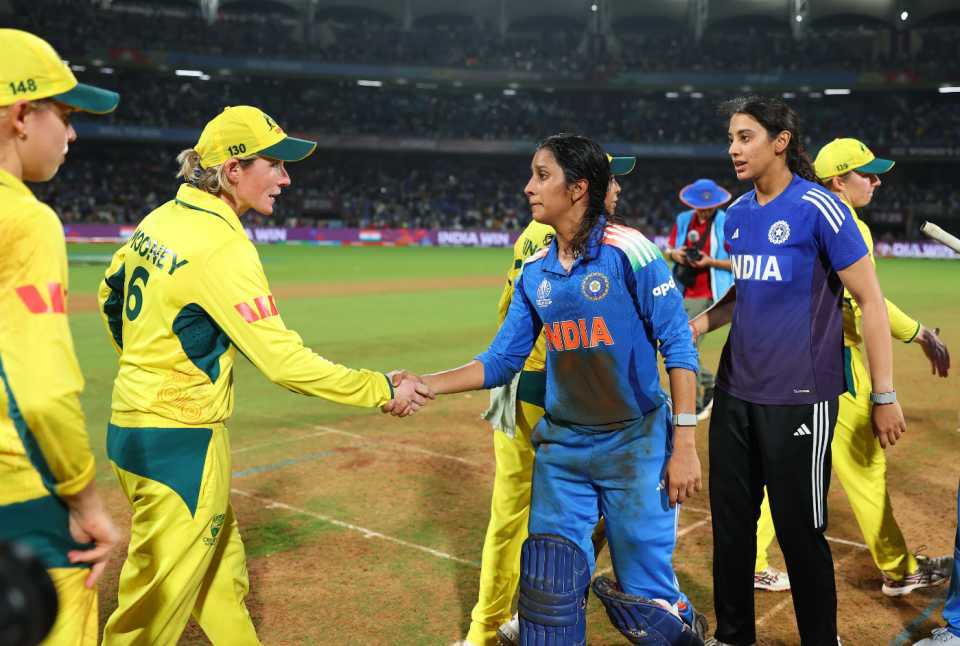
These results illustrate why the teams must adapt their tactics from one match to another. India’s 102-run victory in September 2025 demonstrated the value of a strong batting performance followed by disciplined bowling. Australia’s group-stage World Cup victory showcased their ability to chase a large target, while India’s semi-final success proved that the team could learn from an earlier defeat and execute its plans more effectively.
Batting and Bowling Strategies
Batting often determines the direction of India-Australia contests. Australia traditionally aim to establish a reliable foundation before accelerating, using experienced batters to manage different phases of an innings. Their middle order can increase the scoring rate, while their all-rounders provide flexibility if early wickets fall.
India frequently combine technically sound batting with aggressive stroke play. Openers such as Smriti Mandhana can exploit fielding restrictions, while experienced middle-order batters can rebuild an innings or accelerate when conditions allow. The team’s success often depends on partnerships and avoiding clusters of wickets.
Bowling is equally important. Australian fast bowlers look to exploit movement, bounce, and changes in pace, while their spinners can restrict scoring in the middle overs. India’s bowling attack combines pace and spin, allowing captains to respond to different pitch conditions. Effective field placements, accurate lengths, and variations are essential when facing aggressive batters.
In the india women’s national cricket team vs australia women’s national cricket team contest, the team that controls the middle overs and handles pressure at the end of an innings often gains a decisive advantage.
Venues and Conditions
Playing conditions can significantly influence the outcome of matches between India and Australia. Indian venues may offer slower pitches that assist spin bowling as matches progress, although some grounds also provide excellent conditions for high-scoring games. Familiarity with local conditions can help Indian players make better decisions about batting tempo and bowling changes.
Australian grounds often offer additional bounce and carry, which can benefit fast bowlers. Larger boundaries at some venues may also influence how batters approach their scoring options. Teams must consider weather, pitch preparation, outfield speed, and the effect of dew when deciding whether to bat or bowl first.
Home advantage is therefore an important factor, but it does not guarantee victory. India’s performances in Australia and Australia’s results in India show that preparation and execution can be just as important as familiarity with the ground.
What Makes This Rivalry Special?
Several factors distinguish these teams’ encounters from ordinary bilateral fixtures.
-
High-quality cricket: Both sides possess international experience and players capable of delivering match-winning performances.
-
Strong batting lineups: Their top and middle orders can produce large totals and recover from difficult starts.
-
Tactical competition: Captains must constantly adjust field placements, bowling changes, and scoring plans.
-
Major tournament pressure: World Cup encounters carry additional significance because a single defeat can end a team’s championship ambitions.
-
Growing audience interest: The development of women’s cricket has brought greater attention to these matches and increased opportunities for emerging players.
The rivalry also illustrates the importance of long-term investment in women’s cricket. Better domestic competitions, professional support, coaching, and international exposure help both teams develop the next generation of talent.
Future Outlook for India Women vs Australia Women
The future of this rivalry is likely to remain exciting as both teams continue developing new players and refining their strategies. India can build on their major tournament successes by strengthening bowling consistency, improving fielding standards, and maintaining batting partnerships against quality opposition.
Australia will continue to draw on their established cricketing culture, depth of talent, and experience in high-pressure matches. Their challenge is to remain adaptable as opponents develop new ways to counter their strengths.
For fans, upcoming encounters will provide opportunities to see emerging batters, versatile all-rounders, and specialist bowlers establish themselves at the highest level. The outcome of each series will depend on fitness, form, conditions, and the ability to execute plans when the pressure is greatest.
The growing competitiveness of the india women’s national cricket team vs australia women’s national cricket team rivalry also makes it an important fixture for the wider development of women’s cricket. Strong performances from both teams can inspire young players and demonstrate the skill, athleticism, and strategic depth of the international women’s game.
Conclusion
The India-Australia women’s cricket rivalry combines history, individual brilliance, tactical competition, and memorable tournament drama. Australia have traditionally held the advantage in overall head-to-head results, but India’s progress has produced landmark victories that have reshaped expectations.
From Harmanpreet Kaur’s outstanding 2017 World Cup innings to the dramatic 2025 semi-final chase led by Jemimah Rodrigues, these encounters have created moments that will remain important in women’s cricket history. Australia’s consistency and experience continue to make them formidable opponents, while India’s growing confidence and talent provide the foundation for further success.
Ultimately, the india women’s national cricket team vs australia women’s national cricket team rivalry is about more than wins and losses. It reflects the growth of women’s cricket, the emergence of exceptional athletes, and the continuing pursuit of excellence at the international level. Fans can look forward to many more competitive matches as both teams aim to establish their place among the world’s best.

