

The Texans vs Chargers match player stats provide a detailed look at how individual performances, offensive efficiency, and defensive pressure shaped the contest between the Houston Texans and the Los Angeles Chargers. These AFC teams feature talented quarterbacks, explosive receivers, powerful defensive units, and players capable of changing a game with a single play. Their December 27, 2025, regular-season meeting was particularly competitive, with Houston securing a 20–16 victory at SoFi Stadium.
Houston established an early advantage through two long touchdown passes from quarterback C.J. Stroud, while Los Angeles worked to recover throughout the remaining quarters. Justin Herbert helped the Chargers remain competitive, but Houston’s defensive pressure and timely scoring proved decisive. The final score reflected a contest in which the opening minutes created a significant advantage for the Texans, while the Chargers spent much of the game attempting to close the gap. Examining the passing, rushing, receiving, and defensive numbers helps explain how the teams performed and which players made the biggest contributions.
Texans vs Chargers Match Overview
The December 27, 2025, meeting took place during Week 17 of the NFL regular season. Houston entered the contest seeking to strengthen its playoff position, while Los Angeles aimed to maintain its momentum heading into the postseason. The Texans started aggressively and scored two touchdowns in the first quarter, taking a 14–0 lead. The Chargers responded with a field goal before halftime, reducing the deficit to 14–3.
Houston added a field goal in the third quarter, but Los Angeles answered with a touchdown pass from Herbert to Oronde Gadsden II. Another Texans field goal increased the lead to 20–10 in the fourth quarter. The Chargers scored again through Omarion Hampton’s rushing touchdown, but a missed extra point left them needing another scoring drive. Houston held on for the four-point victory.
| Match Detail | Information |
|---|---|
| Teams | Houston Texans vs Los Angeles Chargers |
| Date | December 27, 2025 |
| Competition | NFL regular season, Week 17 |
| Venue | SoFi Stadium |
| Final score | Texans 20–16 Chargers |
| Texans quarterback | C.J. Stroud |
| Chargers quarterback | Justin Herbert |
| Total net yards | Texans 362, Chargers 275 |
| Result | Houston Texans won |
The Texans gained more total net yards and controlled possession for slightly longer, recording approximately 30 minutes and 21 seconds compared with the Chargers’ 29 minutes and 39 seconds. Houston’s early touchdowns also created a scoring cushion that became increasingly important as the game progressed.
C.J. Stroud played a central role in Houston’s victory, particularly during the opening quarter. He completed 16 of 28 passing attempts for 244 yards, two touchdowns, and two interceptions. Although the interceptions affected his overall efficiency, his ability to connect on two long scoring passes gave the Texans immediate control of the game.
Stroud’s first touchdown was a spectacular 75-yard connection with rookie receiver Jayden Higgins. His second scoring pass traveled 43 yards to Jaylin Noel. These plays demonstrated Houston’s ability to exploit defensive coverage and create explosive gains without requiring lengthy offensive drives. The two touchdowns accounted for all of Houston’s passing touchdowns in the contest.
However, Stroud’s performance became less consistent after the opening possessions. The Chargers adjusted defensively, and Houston found it harder to sustain drives. His two interceptions created opportunities for Los Angeles to return to the game. Nevertheless, Stroud’s early accuracy on deep passes proved decisive because the Texans were able to protect their lead through a combination of defensive pressure and field goals.
His final passing total highlights the difference between explosive production and consistent efficiency. Stroud did not dominate every quarter, but he delivered the most influential offensive plays of the game when Houston needed them most.
Justin Herbert Player Stats
Justin Herbert finished the game with 21 completions on 32 attempts for 236 passing yards, one touchdown, and one interception. He also recorded 37 rushing yards on six carries. His passing production kept the Chargers within reach, but Houston’s defensive front made it difficult for him to establish a consistent rhythm.
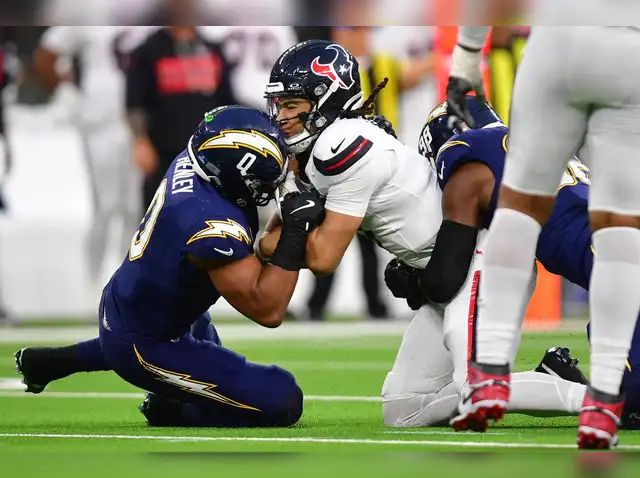
Herbert faced considerable pressure from the Texans’ pass rush. Houston recorded five sacks and repeatedly disrupted passing opportunities, forcing the Chargers to adjust their offensive approach. The pressure was especially damaging because Los Angeles had fallen behind by two touchdowns early in the contest.
Herbert’s touchdown pass to Oronde Gadsden II helped reduce Houston’s lead during the third quarter. He also contributed with his legs, gaining useful yards when passing lanes closed. His mobility offered an additional option against Houston’s defensive pressure, although it was not enough to complete the comeback.
Comparing Herbert’s statistics with Stroud’s shows that both quarterbacks produced more than 230 passing yards and each threw two or more scoring passes only on the Texans’ side. Stroud recorded two touchdowns but also two interceptions, while Herbert finished with one touchdown and one interception. The early scoring difference ultimately mattered more than the relatively close passing-yard totals.
Texans vs Chargers Match Player Stats Table
The following table summarizes several of the leading offensive performances from the December 2025 game.
| Player | Team | Passing Yards | Rushing Yards | Receiving Yards | Total Touchdowns |
|---|---|---|---|---|---|
| C.J. Stroud | Texans | 244 | 0 | 0 | 2 passing |
| Justin Herbert | Chargers | 236 | 37 | 0 | 1 passing |
| Woody Marks | Texans | 0 | 71 | 4 | 0 |
| Jawhar Jordan | Texans | 0 | 36 | 0 | 0 |
| Nico Collins | Texans | 0 | 0 | 57 | 0 |
| Jayden Higgins | Texans | 0 | 0 | 88 | 1 receiving |
| Jaylin Noel | Texans | 0 | 2 | 54 | 1 receiving |
| Quentin Johnston | Chargers | 0 | 0 | 98 | 0 |
| Omarion Hampton | Chargers | 0 | 29 | 31 | 1 rushing |
| Oronde Gadsden II | Chargers | 0 | 0 | 32 | 1 receiving |
Passing, rushing, and receiving figures represent separate statistical categories and should not be added together to calculate a player’s official total yards. Touchdown totals distinguish the type of score recorded.
Houston Texans Rushing Performance
Houston’s rushing attack helped complement Stroud’s passing game and provided balance when the offense needed to control possession. Woody Marks led the Texans with 19 carries for 71 yards, averaging approximately 3.7 yards per attempt. While he did not score a rushing touchdown, his workload helped Houston continue moving the ball and reduce the pressure on its quarterback.
Jawhar Jordan contributed eight carries for 36 yards, averaging 4.5 yards per attempt. His production provided another option in the backfield and helped the Texans maintain a varied offensive approach. Xavier Hutchinson also recorded a rushing attempt for eight yards, while other short carries contributed to the team’s overall ground production.
Houston finished with approximately 118 rushing yards, giving it a useful foundation beyond the passing game. The rushing numbers were not spectacular, but the Texans did not need a dominant ground performance because Stroud’s early touchdowns had already created a significant lead. Their ability to combine rushing attempts with controlled passing plays helped keep the offense functional even after the opening quarter.
The Texans’ rushing performance also mattered late in the contest, when maintaining possession and avoiding unnecessary risks became important. Rather than relying entirely on explosive passes, Houston could use its running backs to move the chains and help protect its advantage.
Los Angeles Chargers Rushing Performance
The Chargers used several players to generate rushing production, with Herbert contributing the largest individual yardage total. He recorded six carries for 37 yards, including a long run of 28 yards. His rushing ability helped compensate for the pressure created by Houston’s defensive line and provided opportunities when conventional passing plays broke down.
Omarion Hampton finished with 14 carries for 29 rushing yards and one touchdown. Although his rushing average was limited, his fourth-quarter score gave Los Angeles a chance to make the closing minutes more competitive. Hampton also contributed significantly as a receiver, catching eight passes for 31 yards.
The Chargers’ running backs struggled to generate consistent gains on the ground, and the team needed to depend on Herbert’s passing and mobility to sustain drives. Houston’s defense limited the effectiveness of the traditional rushing attack, making it harder for Los Angeles to establish the balanced offense required for a comeback.
Nevertheless, Hampton’s touchdown demonstrated the value of continuing to run the ball even when a team is trailing. His contribution kept the Chargers within striking distance, although the failed extra point made the remaining challenge more difficult.
Receiving Stats and Leading Wide Receivers
The receiving numbers reveal how explosive plays influenced the final result. Jayden Higgins led Houston’s receivers with 88 yards on two catches, including the 75-yard touchdown that opened the scoring. Jaylin Noel recorded 54 yards on three receptions and scored on a 43-yard touchdown. Both rookies produced important plays that immediately put the Chargers under pressure.
Nico Collins added three catches for 57 yards, providing another reliable option for Stroud. Xavier Hutchinson caught two passes for 21 yards, while tight end Dalton Schultz recorded three receptions for 19 yards. The distribution showed that Houston could involve multiple players rather than relying on one receiver throughout the contest.
For Los Angeles, Quentin Johnston led all listed receivers with 98 yards on five receptions. His longest catch covered 60 yards, illustrating the Chargers’ ability to create explosive plays even while trailing. Oronde Gadsden II added three catches for 32 yards and scored the Chargers’ receiving touchdown.
Hampton also provided value in the passing game with eight receptions for 31 yards. Although his receiving total was modest, the frequent short catches gave Herbert an outlet against pressure. Overall, Houston’s biggest receiving advantage came from converting two early opportunities into long touchdowns, while Los Angeles generated yardage without matching that opening scoring impact.
Defensive Player Stats and Key Contributions
Defensive performance was one of the strongest reasons Houston secured the victory. The Texans recorded five sacks against Herbert, disrupting the Chargers’ timing and limiting their ability to develop longer passing plays. The pressure was particularly effective given Los Angeles’ offensive-line difficulties during the contest.
Houston’s defense also forced one interception from Herbert and made it difficult for the Chargers to convert their offensive opportunities into touchdowns. Los Angeles reached scoring positions but did not consistently finish drives, leaving the team dependent on late-game production.
Danielle Hunter was a standout contributor to Houston’s pass rush, recording a sack and generating six quarterback pressures, according to NFL game analysis. His work helped demonstrate how pressure can influence a quarterback even when it does not result in a sack on every play.
The Chargers’ defense had a different challenge. After conceding two long touchdown passes in the first quarter, Los Angeles needed to limit further explosive plays. The defense improved as the game progressed, forcing Stroud into two interceptions and helping the offense regain opportunities. However, those adjustments could not erase the early deficit.
This matchup demonstrated that defensive success involves more than total tackles. Sacks, pressure, interceptions, coverage discipline, and red-zone stops all affect the final score. Houston’s ability to disrupt Herbert and protect its lead ultimately proved more valuable than the Chargers’ later defensive improvement.
Key Moments That Influenced the Result
Several moments shaped the Texans’ 20–16 win:
- 75-yard touchdown pass: Stroud connected with Higgins to give Houston an early lead.
- 43-yard touchdown pass: Noel’s scoring reception increased the advantage to 14–0.
- Third-quarter response: Gadsden’s touchdown helped Los Angeles move closer.
- Fourth-quarter field goal: Houston extended its lead to 20–10.
- Hampton’s rushing touchdown: The Chargers narrowed the gap to four points.
- Missed extra point: Los Angeles lost a valuable point during its late comeback attempt.
- Defensive pressure: Houston’s five sacks disrupted the Chargers’ passing attack.
These plays show why the final score cannot be explained by passing yards alone. Houston capitalized on two major early opportunities, while Los Angeles needed sustained drives to overcome the deficit. The Texans’ defense then prevented the Chargers from completing the comeback.
What the Player Stats Reveal
The Texans vs Chargers match player stats demonstrate that explosive passing and defensive pressure can outweigh several otherwise competitive individual numbers. Stroud and Herbert both exceeded 230 passing yards, but Houston’s two early touchdown connections created the most important scoring separation. Houston also recorded more total net yards, with 362 compared with Los Angeles’ 275.
The receiving statistics offer another important lesson. Higgins and Noel combined for two long touchdown receptions, while Johnston led the Chargers with 98 receiving yards without scoring a receiving touchdown. Houston turned a smaller number of high-impact opportunities into points, whereas Los Angeles had to work through a more difficult scoring situation.
The rushing numbers were comparatively balanced in their overall contribution, although Houston’s 118 team rushing yards helped support its passing attack. Meanwhile, Herbert’s 37 rushing yards showed his willingness to create opportunities outside the pocket.
For fans evaluating future matchups, the most useful statistics to monitor are quarterback efficiency, sacks allowed, third-down conversions, turnovers, red-zone success, and explosive plays. These measurements help explain why a team wins beyond what the final score reveals.
Conclusion
The Houston Texans defeated the Los Angeles Chargers 20–16 on December 27, 2025, through explosive early passing, productive receiving plays, and a defense that consistently pressured Justin Herbert. C.J. Stroud completed 16 of 28 passes for 244 yards and two touchdowns, while Herbert recorded 236 passing yards, one touchdown, one interception, and 37 rushing yards. Woody Marks led Houston’s rushing attack, Jayden Higgins and Jaylin Noel delivered key touchdown receptions, and Quentin Johnston topped the Chargers’ receiving chart with 98 yards.
The Texans vs Chargers match player stats highlight the importance of converting big plays into points and maintaining defensive pressure when protecting a lead. Although Los Angeles mounted a late challenge, Houston’s opening-quarter advantage and stronger defensive performance proved decisive. The game serves as a useful example of how quarterback decisions, receiver production, rushing contributions, and defensive execution work together to determine an NFL result.

